One box — several machines
An industrial mini-PC controls several machines at once — each isolated, in hard real time. Runs on your network, no cloud. One machine going down doesn't affect the others.
Local, deterministic, isolated
Each EtherCAT port is a separate machine in its own real-time loop. Monitoring can go to the cloud or stay at the edge — the execution loop is always local regardless.
A single bus here isn't aesthetics, it's a requirement. Several protocols on one box driving several machines is engineering chaos: nothing can be kept track of, and machine determinism and isolation break down. That's why the box runs EtherCAT only.
The control and monitoring server can run in the cloud — or the entire stack can be deployed locally, on-prem, all the way to air-gapped. Either way, the execution loop stays on the local box.
Machines under one twin
Different kinematics — mill, laser, lathe, KUKA robot — as live connections to the real-time loop, each with its own state.
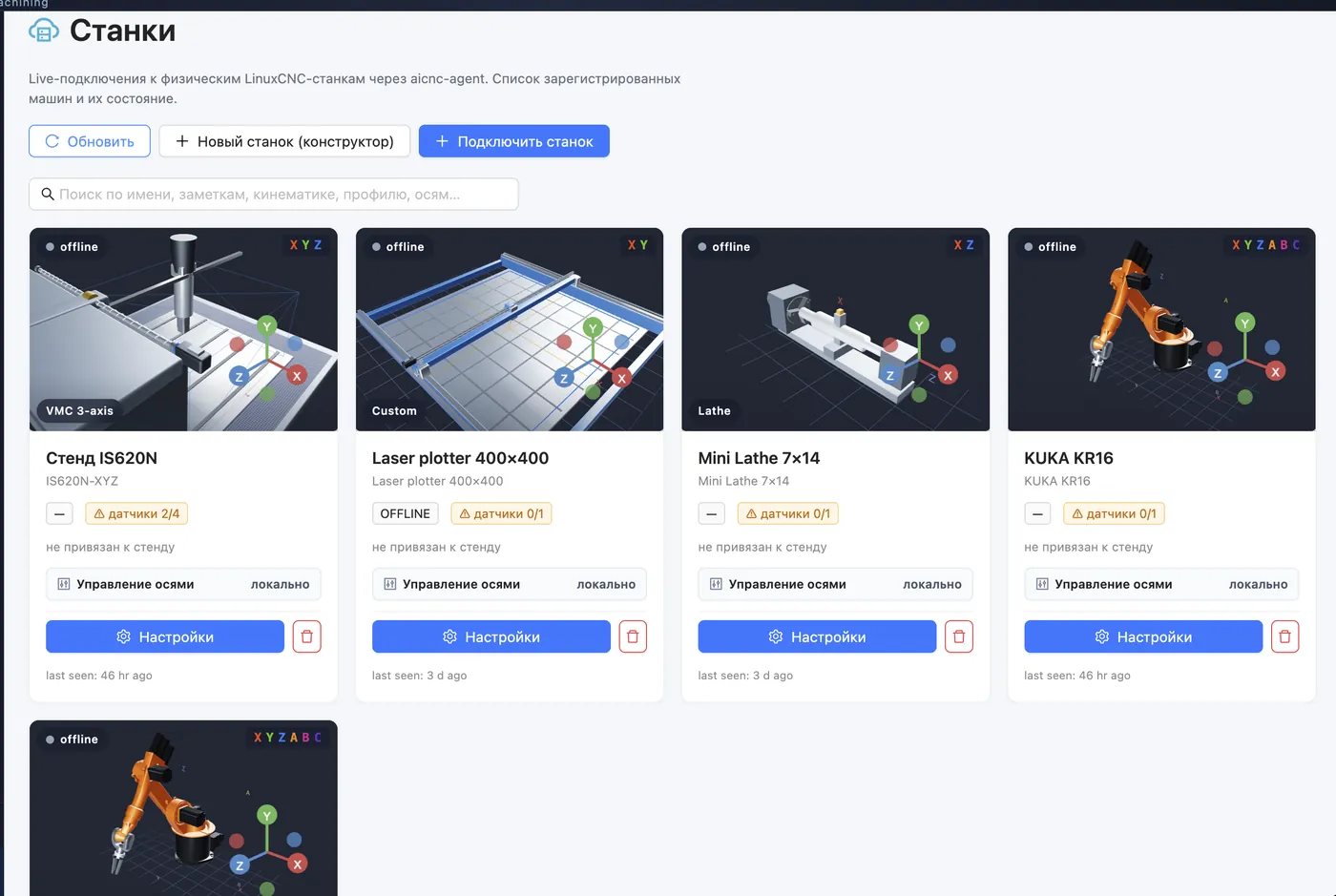
Resources are allocated per machine
Machine isolation isn't a slogan — it's a concrete hardware allocation. Each machine gets its own real-time loop and its own network, plus a separate budget for management and the box's own system.
2 cores per machine
Two dedicated cores for each machine's RT stream — hard real time with no contention for the processor.
1× Intel i226 per machine
A dedicated 2.5GbE port (Intel i226) for each machine — its own EtherCAT bus, no traffic shared between machines.
8 cores · 4× i226
An 8-core box with 4 i226 ports — up to three isolated machines plus a management port.
Multi-vendor hardware on one bus
The bus is EtherCAT only; equipment on other protocols connects through converters. The drive profile library grows through ESI parsing and bench verification — the range of supported equipment expands with every onboarding.
CiA-402 servo drives
Verified on the bench: Inovance IS620N, Wecon VD3E — end-to-end, from onboarding to axis motion. ESI onboarding: Mitsubishi, Estun, Schneider, and others — on one EtherCAT bus, normalized to a single object model.
From mills to robot manipulators
Milling and turning machines are the working loop. Industrial robot manipulators (6-axis, welding), robotic cells, and parallel kinematics — hexapod (Stewart platform), linear delta, tripod — are an R&D direction. Forward and inverse robot kinematics are computed in the twin and executed over EtherCAT.
An open RT engine
An open deterministic executor beneath our control layer. The brain sits on top, coordination underneath.